
⚠️ Disclaimer: This article is for educational purposes only and does not constitute financial advice. Always consult a qualified financial advisor before making major financial decisions.
Here’s something nobody tells you about saving money on a low income.
Most money-saving advice is written by people who already have plenty of it. They tell you to “cut your daily latte” or “cancel your subscriptions” — as if that’s going to change your life. It’s frustrating, tone-deaf, and honestly? It misses the point completely.
These money saving tips for beginners with low income are different. They’re written for people who are genuinely starting from scratch — maybe paycheck to paycheck, maybe with debt, maybe with nothing saved at all.
Because here’s what I know for certain: saving money on a low income is harder than saving money when you’re already comfortable. But it’s not impossible. In fact, the habits you build now — when every dollar counts — will make you more financially disciplined than most people who earn twice as much.
Let’s get into it. ☕💰
Why Saving Money on a Low Income Feels Impossible
Before we dive into the tips, let’s acknowledge something real: saving money when you barely have enough to cover your bills is genuinely difficult. It’s not a mindset problem. It’s not laziness. Sometimes the math doesn’t work.
But here’s what changes everything: even saving $10 a week builds the habit. And the habit — not the amount — is what eventually changes your financial life.
These money saving tips for beginners with low income focus on what’s actually possible — starting from wherever you are right now.
Tip 1: Pay Yourself First — Even Just $5
The most powerful money saving tip for beginners with low income sounds almost too simple: the moment you get paid, move money into savings before you spend anything else.
Not $500. Not $200. Even $5 or $10. The amount doesn’t matter at first — the habit does.
- Set up automatic transfer on payday — even $5
- Use a separate savings account so you don’t see it daily
- Increase the amount by $5 every month — you won’t feel it
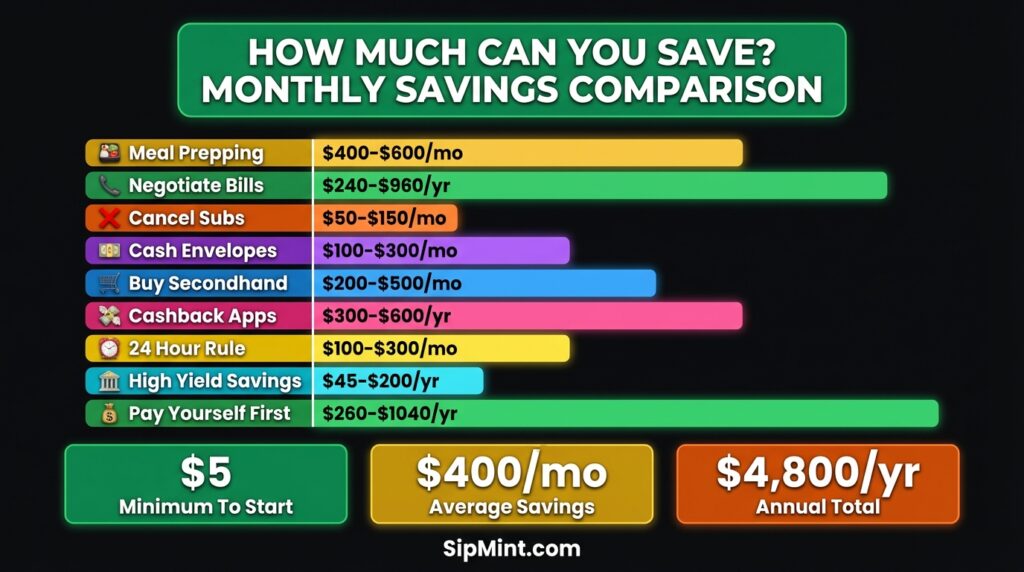
$5/week = $260/year. $20/week = $1,040/year. It adds up faster than you think — and it starts with the very next paycheck.
Tip 2: Track Every Single Dollar You Spend
You cannot fix what you cannot see. Most people with low income are shocked when they actually track their spending — because small leaks are silently draining their money every month.
- Free apps: Mint, YNAB (free trial), Google Sheets
- Write down every expense for 30 days — no matter how small
- Review at the month’s end — find your biggest surprise expenses
Most people find $50-$200 per month in spending they didn’t even realise they were doing. That money — redirected into savings — changes everything.
Tip 3: Use the 50/30/20 Budget Rule
The 50/30/20 rule is the simplest budget framework for beginners — and it works on any income level.
- 50% — Needs: Rent, food, utilities, transport
- 30% — Wants: Entertainment, dining out, clothes
- 20% — Savings: Emergency fund, investments, debt payoff
On a low income, 20% savings might not be possible right away. Start with 5% or 10% — and work your way up. The structure matters more than the exact percentages.
Tip 4: Cut Your 3 Biggest Expenses First
Forget cutting your coffee. The biggest impact comes from cutting your 3 biggest expenses — which for most people are housing, transport, and food.
- Housing: Get a roommate, move somewhere cheaper, negotiate rent
- Transport: Use public transport, carpool, bike, or walk when possible
- Food: Cook at home, meal prep Sundays, buy in bulk, use store brands
Cutting $100 from your rent saves more than cutting 100 cups of coffee. Always attack the biggest expenses first — small cuts on big bills beat big cuts on small bills every time.
Tip 5: Cancel Subscriptions You Forgot About
The average person pays for 3-4 subscriptions they never use. These silent money drains quietly drain $50-$150 per month from your account without you even noticing.
- Check your bank statement for recurring charges right now
- Cancel anything you haven’t used in the last 30 days
- Use free alternatives: Spotify free, YouTube, library apps
Right now — open your bank app. Scroll through last month’s transactions. How many recurring charges do you see that you completely forgot about? Cancel them today.
Tip 6: Build a $1,000 Emergency Fund First
Before investing. Before paying extra on debt. Before anything else — build a $1,000 emergency fund. This single step stops the cycle of financial emergencies destroying your savings every time something unexpected happens.
- Keep it in a separate savings account — not your main account
- Only use it for TRUE emergencies — car repair, medical, job loss
- Rebuild it immediately after using it
$1,000 saved = no more credit card debt for small emergencies. It’s the single most important financial step a beginner with a low income can take.
Tip 7: Use Cash Envelopes for Problem Spending
If you overspend in certain categories — food, entertainment, clothes — the cash envelope method is one of the most effective money saving tips for beginners. When the cash runs out, the spending stops. Simple.
- Identify your 2-3 biggest overspending categories
- Withdraw that budget in cash at the start of each month
- Put cash in labelled envelopes — when it’s gone, it’s gone
Spending cash physically hurts more than swiping a card. That tiny psychological pain is exactly what makes this method so powerful for people who struggle with overspending.
Tip 8: Meal Prep Every Sunday
Food is the most controllable big expense in your budget. And meal prepping on Sundays is the single most effective way to cut your food bill by 40-60% — while eating healthier at the same time.
- Cook 5 days of meals in 2 hours every Sunday
- Buy ingredients in bulk — rice, beans, chicken, and vegetables
- Cost: $40-$60/week vs $150-$200 buying food daily
The math is brutal in your favour: meal prepping saves $400-$600 per month for the average person. That’s $4,800-$7,200 per year — from one Sunday afternoon habit.
Tip 9: Use the 24-Hour Rule Before Every Purchase
Impulse buying is the silent killer of savings accounts. The 24-hour rule is simple: before buying anything that isn’t food or a bill — wait 24 hours. If you still want it tomorrow, buy it. Most of the time? You won’t.
- Add item to wishlist instead of buying immediately
- Wait 24 hours — 48 hours for purchases over $50
- Ask yourself: Do I need this or just want it right now?
Studies show that 70% of impulse purchases feel regrettable within 24 hours. This one rule alone can save beginners with low income $100-$300 per month without feeling deprived.
Tip 10: Negotiate Your Bills — It Actually Works
Most people never negotiate their bills. But your internet provider, phone company, and insurance company will lower your rate — if you just ask. Companies would rather keep you at a lower rate than lose you to a competitor.
- Call your internet/phone provider — ask for current promotions
- Say: “I’m considering switching — can you offer a better rate?”
- Average savings: $20-$80/month — that’s $240-$960/year!
One 10-minute phone call can save you hundreds of dollars per year. That’s the highest hourly rate you’ll ever earn — and it requires zero special skills.
Tip 11: Buy Secondhand First
Before buying anything new — clothes, furniture, electronics, appliances — always check secondhand first. Facebook Marketplace, eBay, thrift stores, and Craigslist are full of high-quality items at 50-90% off retail price.
- Facebook Marketplace — local deals, often free pickup
- Thrift stores — clothes and household items for cents on the dollar
- eBay — electronics, books, tools at massive discounts
A $500 sofa on Amazon might be $80 on Facebook Marketplace in perfect condition. A $200 phone might be $60 refurbished. Buy secondhand first — always.
Tip 12: Use Cashback Apps and Coupons
Getting paid to shop sounds too good to be true — but cashback apps make it real. You’re buying things anyway. You might as well get money back every single time.
Rakuten — earn 1-15% cashback at major stores
- Ibotta — cashback on groceries and everyday purchases
- Honey browser extension — automatic coupon codes at checkout
- Google “[store name] coupon code” before every online purchase
Average cashback user saves $300-$600 per year doing absolutely nothing different — just shopping through the app instead of directly. Free money.
Tip 13: Increase Your Income — Even by $200/Month
Here’s a truth about money saving tips for beginners with low income that nobody wants to say: sometimes the income is just too low to save meaningfully — no matter how many tips you follow.
In that case, increasing income — even slightly — changes everything. An extra $200/month is $2,400/year. That alone can build your emergency fund, pay off a credit card, or start an investment account.
- Freelance on weekends: writing, design, video editing
- Sell unused items on Facebook Marketplace or eBay
- Deliver food with DoorDash or Uber Eats on evenings
You don’t need a second full-time job. Just $50-$100 extra per week from a side hustle, redirected entirely into savings, can completely transform your financial picture within a year.
Tip 14: Move Your Savings to a High-Yield Account
If your savings are sitting in a regular bank account earning 0.01% interest — you’re leaving free money on the table. High-yield savings accounts pay 4-5% annually — meaning your money grows just by sitting there.
- Regular savings account: 0.01% interest = $1/year on $1,000
- High-yield savings: 4.5% = $45/year on same $1,000
- Best options: Marcus, Ally Bank, SoFi — all free, no minimums
Moving your savings takes 10 minutes online. It costs nothing. And it immediately starts earning you more money on every dollar you’ve already saved. Do it today.
Tip 15: Celebrate Small Wins — Stay Motivated
Saving money on a low income is genuinely hard. And the biggest reason people quit isn’t lack of discipline — it’s lack of motivation when progress feels slow.
Celebrate every milestone — no matter how small. Saved your first $100? Celebrate. Reached $500? Celebrate. Paid off a credit card? Big celebration.
- Set small milestones: $100, $500, $1,000, $2,500
- Reward yourself cheaply — a nice meal, a movie, a day off
- Track visually — a savings chart on your wall works wonders
Progress — no matter how slow — is still progress. The person who saves $50/month for 3 years is infinitely better off than the person who planned to save $500/month and never started.
Ready to Grow Your Money Further?
Once you’ve built your savings habit, the next step is making your money work for you. Check out these guides on SipMint:
Frequently Asked Questions
Q: What are the best money saving tips for beginners with low income?
The best money saving tips for beginners with low income are: pay yourself first (even $5), track every dollar, cut your 3 biggest expenses, build a $1,000 emergency fund, and use the 24-hour rule before purchases. Start with just one tip this week.
Q: How much should a beginner with a low income save per month?
Start with whatever you can — even $10-$20/month. The goal is building the habit first, then increasing the amount. Even $50/month saved consistently for 5 years = $3,000+ plus interest. Small amounts compound into big results.
Q: Can you save money when living paycheck to paycheck?
Yes — but it requires two things: finding small amounts to redirect into savings (even $5-$10), AND looking for ways to increase income slightly. Tracking spending almost always reveals $50-$100 per month in unnecessary expenses that can be redirected to savings immediately.
The Bottom Line
These money saving tips for beginners with low income work — but only if you actually use them. Reading this article is the easy part. The hard part is opening your bank app right now, checking your subscriptions, and moving even $10 into savings today.
You don’t need a high income to start saving. You need a system, a habit, and the patience to let small actions compound over time.
Pick just ONE tip from this list. Implement it today. Then come back next week and add another.
Financial freedom doesn't start with a big salary. It starts with one small decision — made today. ☕💰
⚠️ Financial Disclaimer: This article is for informational and educational purposes only. It does not constitute financial advice. Always consult a qualified financial advisor before making major financial decisions.
— SipMint.com | Mint Money While You Sleep —