⚠️ Disclaimer: This article is for educational purposes only and does not constitute financial advice. Investing involves risk. Always do your own research before investing any money.
So you want to start investing — but you only have $100.
First of all — good for you. Seriously. The fact that you’re even thinking about investing with $100 instead of spending it puts you ahead of most people your age. Most people wait until they have “enough” money to invest. Spoiler: that day never comes.
Here’s what nobody tells beginners about how to start investing with $100: the amount doesn’t matter at first. The habit does. The knowledge does. The action does.
In this guide, I’m going to walk you through exactly how to start investing with $100 — in plain, simple English. No jargon. No confusing charts. Just real, actionable steps you can take today.
Let’s go. ☕💰
Why $100 Is Actually Enough to Start Investing
A lot of people think investing is only for rich people. “I’ll start when I have more money” — sound familiar? Here’s the truth: you don’t need thousands of dollars to start investing. You need $100 and the right knowledge.
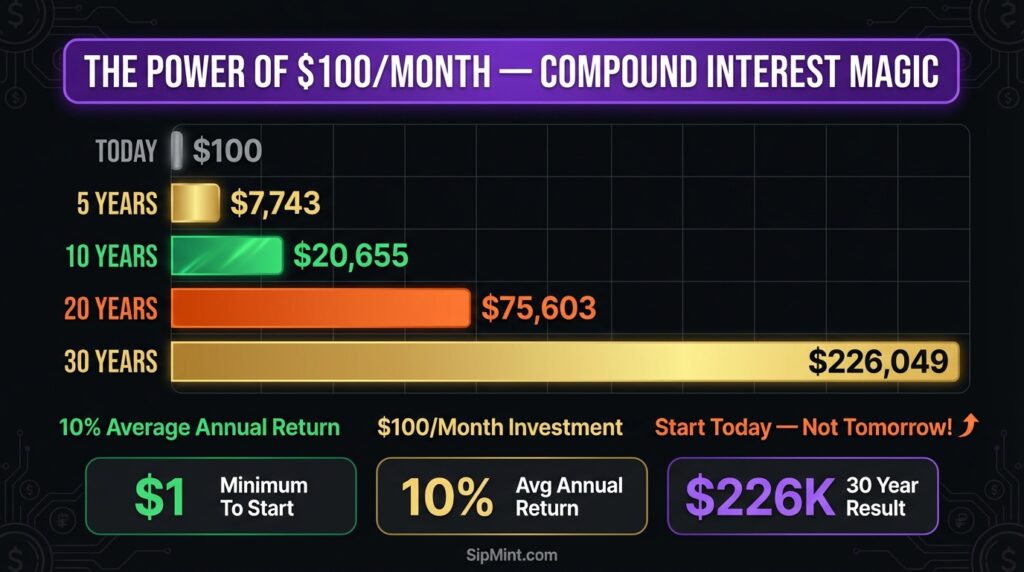
Let me show you something powerful. If you invest just $100 today and add $100 every month at a 10% average annual return:
- After 5 years → $7,743
- After 10 years → $20,655
- After 20 years → $75,603
- After 30 years → $226,049 — from just $100/month!
That’s the magic of compound interest. Your money makes money — which then makes more money. And it all starts with that first $100. The earlier you start, the more powerful it becomes.
What Is Investing? (Simple Explanation for Beginners)
Investing simply means putting your money to work so it grows over time. Instead of your $100 sitting in a bank account earning almost nothing — it goes into assets that increase in value.
Think of it like planting seeds. You plant $100 today. With time and the right conditions — it grows into $500, $1,000, $10,000. You don’t dig it up every week. You let it grow.
Main types of investments:
- Stocks — buying a small ownership in a company
- Index Funds — buying a basket of many stocks at once
- ETFs — similar to index funds, traded like stocks
- Bonds — lending money to the government/companies for interest
As a complete beginner with $100, you only need to focus on ONE thing: index funds. Everything else can wait.
Step 1: Build a $1,000 Emergency Fund First
Wait — before you invest that $100, I need to ask you one question: do you have an emergency fund?
An emergency fund is 3-6 months of expenses saved in a safe place — NOT invested. This is money for real emergencies: job loss, medical bills, and car breakdown.
If you don’t have one yet — save your first $1,000 before investing. Here’s why:
- Investments can lose value in the short term
- If an emergency hits, you might need to sell at a loss
- Emergency fund = a financial safety net that protects your investments
Once you have $1,000 in an emergency fund — every extra dollar can go into investments. That’s when the real wealth building begins.
Step 2: Choose the Right Investment App for $100
Ten years ago, investing $100 wasn’t even possible — minimum investments were thousands of dollars. Today, apps let you start with literally $1. Here are the best platforms for beginners:
- Robinhood — free trades, fractional shares, beginner friendly. Perfect for your first $100.
- Acorns — rounds up your purchases and invests the spare change automatically. Great for absolute beginners.
- Fidelity — no minimums, excellent index funds, best long-term option.
- M1 Finance — automated investing, great for a set-and-forget strategy.
For absolute beginners with $100: start with Robinhood or Fidelity. Both are free, both allow fractional shares, and both are trusted by millions of investors worldwide.
Step 3: Understand Index Funds — Your Best Friend as a Beginner
If there’s one thing I want you to remember from this entire guide, it’s this: as a beginner learning how to start investing with $100, put your money in index funds.
An index fund is like a shopping basket that automatically contains shares of the 500 biggest companies in America — Apple, Microsoft, Amazon, Google, Tesla — all at once.
Why index funds are perfect for beginners:
- Instant diversification — you own 500 companies at once
- Low fees — as little as 0.03% per year
- Historical average return: 10% per year
- Completely passive — no research, no stock picking needed
Best index funds for beginners:
- VOO — Vanguard S&P 500 ETF (0.03% fee)
- SPY — SPDR S&P 500 ETF (0.09% fee)
- FXAIX — Fidelity 500 Index Fund (0.015% fee — lowest!)
Warren Buffett — the world’s greatest investor — recommends index funds for everyday investors. If it’s good enough for him to recommend, it’s good enough for us.
Step 4: Use Tax-Advantaged Accounts First
Before investing in a regular account, check if you qualify for a tax-advantaged account. These are special accounts where your money grows tax-free — meaning you keep more of your returns.
- Roth IRA (USA) — contribute up to $7,000/year. Pay tax now, withdraw TAX FREE at retirement. Best account for young investors.
- 401(k) (USA) — if your employer matches contributions, invest there FIRST. It’s literally free money.
- ISA (UK) — invest up to £20,000/year completely tax free.
If your employer offers a 401(k) match and you’re NOT taking it — you’re leaving free money on the table every single month. Always take the full employer match first.
Step 5: Invest Your First $100 — Here's Exactly How
Okay. Emergency fund? Check. App downloaded? Check. Now let’s actually invest that $100. Here’s exactly what to do:
- Open Robinhood or Fidelity — takes 5 minutes
- Verify your identity and link your bank account
- Deposit $100 into your account
- Search for “VOO” or “FXAIX” (S&P 500 index fund)
- Buy $100 worth — fractional shares available
- Set up an automatic $50-$100 monthly investment
That’s it. You’re now an investor. It took less time than watching a YouTube video. Now the most important thing: don’t touch it. Let it grow.
Step 6: Automate Your Investments — Set It and Forget It
The secret weapon of every successful investor? Automation. Set up automatic monthly investments and never think about it again.
Here’s why automation is so powerful:
- You invest before you have a chance to spend it
- You buy more shares when prices are low automatically
- No emotions — no panic selling, no FOMO buying
- Consistency beats timing the market every single time
Set up $50 or $100 automatic investment on payday. In 10 years, you’ll look back at this decision as one of the best you ever made.
Step 7: Never Do These 5 Things as a Beginner Investor
Just as important as knowing what to do — is knowing what NOT to do. These 5 mistakes cost beginners thousands of dollars every year.
- ❌ Don’t panic sell when the market drops — it ALWAYS recovers
- ❌ Don’t try to time the market — nobody can predict it consistently
- ❌ Don’t invest money you need in the next 1-2 years
- ❌ Don’t put all money in one stock — diversify always
- ❌ Don’t chase “hot” investments or crypto tips from strangers
The stock market goes up and down every day. That’s completely normal. The investors who win are the ones who stay calm, stay invested, and keep adding money consistently — regardless of what the market is doing.
Step 8: Keep Learning — Free Resources for Beginner Investors
Investing is a skill — and like any skill, the more you learn, the better you get. Here are the best FREE resources to keep growing your investment knowledge:
- Books: “The Little Book of Common Sense Investing” by John Bogle — the index fund bible
- YouTube: Graham Stephan, Andrei Jikh, Mark Tilbury — free investing education
- Websites: Investopedia.com — free financial dictionary and guides
- Podcasts: “We Study Billionaires”, “Invest Like the Best” — listen during commute
Spend 15 minutes a day learning about investing. In one year, you’ll know more than 90% of people. In five years, you’ll be making financial decisions that most people never learn to make.
Build More Wealth Alongside Investing
Investing is just one piece of the wealth puzzle. While your investments grow, check out these guides to build even more income streams:
Frequently Asked Questions
Q: How to start investing with $100 as a complete beginner?
The best way to start investing with $100 is to open a free account on Robinhood or Fidelity, deposit your $100, and purchase an S&P 500 index fund, such as VOO or FXAIX. Then set up automatic monthly investments of $50-$100. That’s it — you’re investing.
Q: Is $100 enough to start investing?
Absolutely! $100 invested today and growing at 10% annually becomes $1,745 in 30 years without adding anything. Add $100/month and it becomes $226,000. The amount matters less than starting early and being consistent.
Q: What is the safest investment for beginners with $100?
The safest investment for beginners with $100 is an S&P 500 index fund. It’s diversified across 500 companies, has low fees, and has historically returned around 10% per year over long periods. It’s what Warren Buffett himself recommends for everyday investors.
The Bottom Line
Now you know exactly how to start investing with $100. The path is simple. The tools are free. The opportunity is massive.
You don’t need to be rich to start investing. You don’t need to understand the stock market perfectly. You need to take that first step — open an account, deposit $100, buy an index fund — and let time do the rest.
The best time to start investing was 10 years ago. The second best time is today.
Your $100 investment today could be worth $100,000 someday — but only if you start. ☕💰
⚠️ Financial Disclaimer: This article is for informational and educational purposes only. It does not constitute financial advice. Investing involves risk of loss. Past performance does not guarantee future results. Always consult a qualified financial advisor.
— SipMint.com | Mint Money While You Sleep —